HomeBlog
5 min read

Popular Study Abroad Countries

Summarise with AI
Popular Study Abroad Countries

AN RISING NUMBER OF OVERSEAS LEARNERS IN AMERICA AND CANADA

AN RISING NUMBER OF OVERSEAS LEARNERS IN AMERICA AND CANADA

Back in 1999, when I first came to the U.S. for my undergraduate studies, I was part of a cohort of roughly half a million global students. Following the events of 9/11, that figure remained relatively flat for the next six to seven years before rebounding vigorously. At present, more than a million foreign students — specifically 1,078,822 — are enrolled in American colleges and universities. Based on the newest Open Doors report from the Institute of International Education (IIE), this marks a 3.4 percent rise compared to 2016 and doubles the figures seen a decade ago. Chinese and Indian scholars have largely propelled this growth, making up half of the entire international student population in the U.S. with respective year-over-year increases of 6.8 percent and 12.3 percent.

Figures for the 2016–2017 period demonstrate that the influx of new arrivals remained stable at 290,836, echoing the record-setting years of 2014–2015 (293,766) and 2015–2016 (300,743). Had scholarship initiatives in countries like Brazil (which saw a 32 percent yearly drop) and Saudi Arabia (with a 14 percent yearly drop) remained fully funded, the U.S. might well have experienced an overall surge in newly arriving international students this year.

Given the current administration's stance on immigration (highlighted by actions such as the Mexican border wall, travel restrictions, and the repeal of DACA, among numerous policy statements), these sustained high figures might surprise some observers. Nevertheless, according to the IIE, the steady annual expansion of international student enrollment over the past six decades highlights a distinct resilience against political turbulence in the United States.

Canada has likewise witnessed a boom in its international student numbers, nearly tripling over the last ten years to reach 415,000. In fact, a 17 percent year-over-year increase in incoming foreign students during 2016 hints at potential further acceleration. Similar to the U.S., students from China and India represent the lion's share of this population, jointly accounting for over half of all international enrollees.

$49 BILLION IN IMMEDIATE ECONOMIC VALUE, FOLLOWED BY MUCH MORE POST-GRADUATION

$49 BILLION IN IMMEDIATE ECONOMIC VALUE, FOLLOWED BY MUCH MORE POST-GRADUATION

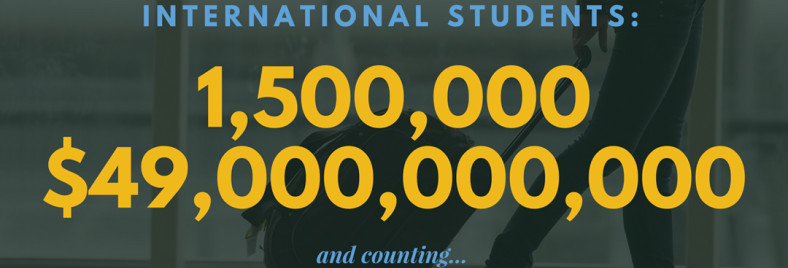
International scholars contribute significantly to national economic development. Together, the 1.5 million foreign students in the U.S. and Canada inject approximately 49 billion USD annually through direct expenditures on tuition and living costs. To grasp the scale of this figure, $49 billion exceeds the GDP of roughly half the nations globally. Furthermore, these metrics only reflect their time spent in school — immigrant scholars generate even greater financial impact after completing their education. For instance, a 2016 study by the National Foundation for American Policy revealed that around half of all U.S. unicorn companies (startups valued above $1 billion) included at least one immigrant co-founder. The report noted, “The combined valuation of these 44 immigrant-led businesses stands at $168 billion, nearly matching half the market capitalization of the Russian or Mexican stock exchanges.”

SEVERAL WORLDWIDE FACTORS ARE FUELING THIS EXPANSION

SEVERAL WORLDWIDE FACTORS ARE FUELING THIS EXPANSION

The fundamental drivers behind international student growth point toward prolonged increases in the years ahead. Data from the Open Doors 2016 presentation indicates that demographic expansion abroad is the principal catalyst. Worldwide, there are 1.2 billion individuals aged 20 to 30. Compared against the 24 million total college enrollees in the U.S. and Canada, it becomes clear why even a small fraction of this vast demographic pursuing higher education in North America can yield substantial effects. Aside from demographics, difficulties in securing admission to intensely competitive local universities in their home nations also motivate international learners to pursue top-tier schooling abroad.

Ultimately, while obtaining a world-class education is priceless, it also delivers major financial rewards for the students themselves. Research conducted at my enterprise, MPOWER Financing—which provides loans to high-potential international scholars attending leading U.S. universities—indicates that the typical yearly earnings for applicants from India (our primary market) before moving to the U.S. for a master's degree sit below $20,000. Following graduation, their salaries increase by two to seven times that baseline, varying according to whether they head home or remain in the U.S. for employment, as well as their specific employer and job title.

A ROBUST TREND THAT DESERVES WELCOME

A ROBUST TREND THAT DESERVES WELCOME

We are witnessing the profound positive influence that international students arriving in the U.S. and Canada bring to our respective nations. Considering the economic contributions these scholars make both during and after their studies, this movement is something we ought to enthusiastically support and foster.

Nonetheless, political perspectives regarding these students differ sharply between the U.S. and Canada. Ottawa has established the attraction and retention of top global talent as a national priority via proactive outreach and the express entry permanent residency pathway for skilled professionals. Conversely, Washington has yet to expand H1B visa quotas to match high-skilled labor demands, delayed the startup visa initiative, and still lacks an efficient pathway to residency for international talent. Prominent media outlets, ranging from the New York Times to The Economist, have pointed out that these disparities—coupled with lower average tuition rates in Canada—have helped drive a steeper rise in international enrollment north of the border compared to the U.S.

To fully capitalize on the steady expansion of international students and the economic advantages they provide host countries, the U.S. would benefit from adopting strategies utilized by its northern neighbor to cultivate this massive talent pool.


About the author

Emmanuel “Manu” Smadja serves as the co-founder and CEO of MPOWER Financing, a rapidly expanding FinTech startup offering educational funding to high-potential foreign students at premier North American universities. Having once been an international student himself, Manu strongly advocates that credit systems should transcend borders and account for an individual's future earning potential.

Note: This is a featured article. This article is not curated by Ashiraj.

You Might Also Like